
Office Interior Design in Dubai: The Workplace Trends Shaping 2026
The Dubai workplace is being reshaped faster than at almost any point in its history. As the emirate solidifies its status as a global business hub, employers from Business Bay to Dubai Internet City are reconsidering what an office is actually for. Together, hybrid working, fierce competition for talent, and ambitious sustainability targets are redrawing every floor plate. By 2026, the office is less a place to sit at an assigned desk and more a destination designed to bring people together. Interior design lies at the very centre of this shift, quietly translating corporate strategy into physical space. This report walks through the trends defining Dubai office design this year, with practical detail for anyone planning a fit-out. Throughout, realistic 2026 market figures ground the vision firmly in reality.
Trend One — Designing Hybrid-First
The biggest shift of all is that offices are no longer built around one fixed desk per person. As hybrid schedules become the norm across Dubai, many organisations plan for roughly 70 to 80% as many desks as employees. That reclaimed space is redirected into collaboration zones, meeting rooms, and social areas that actively draw people in. Given bookable desks, focus pods, and activity-based settings, employees can pick the right spot for each task of the day. This approach can visibly shrink leased area, an appealing prospect given prime Dubai office rents. Designing for a interior design firm in dubai mobile population, though, depends on excellent acoustics, clear wayfinding, and reliable booking technology. When it is done well, a hybrid-first layout feels generous and energising rather than merely efficient.
Trend Two — Wellness and Biophilic Design
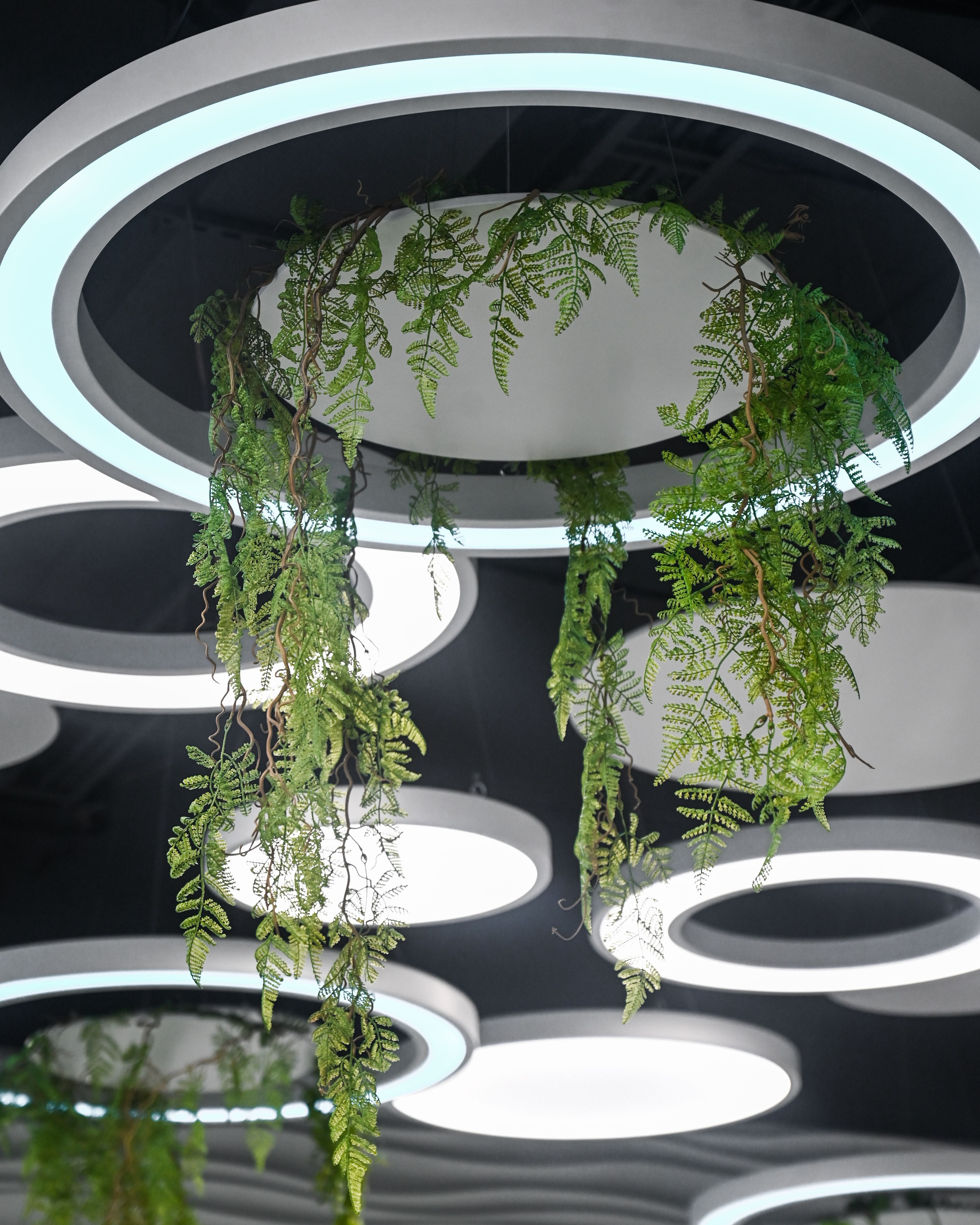
Employee wellbeing has moved squarely from a nice perk to a core design brief. Reconnecting people with nature, biophilic design is one of the strongest currents running through 2026 Dubai interiors. The newest fit-outs lean heavily on living walls, generous planting, natural timber, and abundant daylight. Access to greenery and views, repeatedly linked to lower stress and sharper focus, are something employers increasingly take seriously. Rounding out the wellness toolkit are air quality, ergonomic furniture, and circadian lighting that mimics the natural day. When working days get genuinely intense, quiet rooms and dedicated wellness spaces give staff somewhere to reset. In a city of glass towers, bringing nature indoors has become a genuine advantage.
- Living walls and clustered planting throughout work and break areas
- Circadian lighting that adjusts warmth to the time of day
- Quiet rooms, prayer rooms and dedicated wellness spaces
- Ergonomic, height-adjustable furniture set as the default
Trend Three — Sustainability and Net-Zero Projects
Sustainability is no longer optional for any serious Dubai employer. The UAE’s Net Zero 2050 commitment and Dubai Municipality’s evolving 2026 fit-out guidelines are nudging greener choices right across the board. Designers today routinely specify low-emission materials, recycled and rapidly renewable finishes, and energy-efficient lighting and cooling. More and more, frameworks like LEED and WELL are specified in project briefs from the very outset. Reusing existing partitions, furniture, and services cuts both project cost and embodied carbon at the same time. In a climate where air conditioning dominates energy use, efficient mechanical and cooling design matters enormously. Beyond mere compliance, a demonstrably sustainable office has become a powerful signal to clients and recruits alike.
Trend Four: Smart Offices and Integrated Technology
These days, technology is woven invisibly into the very fabric of the workplace. Smart building systems pull lighting, cooling, and occupancy sensing into a single intelligent platform. Come 2026, room-booking screens, app-based desk reservation, and seamless video conferencing are expected rather than exceptional. Occupancy data lets facilities teams see how space is really used and adjust it over time. Touchless entry, automated blinds, and voice or app control deliver both convenience and welcome hygiene. The best designs deliberately conceal this complexity, so the technology serves people without dominating the aesthetic. For forward-thinking firms in Dubai, a genuinely smart office is fast becoming the baseline expectation.
Trend Five: Quiet Luxury Reaches the Workplace
The loud, logo-heavy office is quietly being replaced by a more understated confidence. Long established in Dubai homes, quiet luxury has now arrived firmly in the workplace. Imagine warm minimalism, natural stone, rich timber, tactile textiles, and a restrained palette rather than bold corporate colour. More and more, reception areas and boardrooms resemble the lobby of a fine hotel, projecting calm assurance to every visitor. Designers pick high-quality materials that age gracefully over trend-driven finishes that quickly date and tire. This mood fits well with wellness and sustainability, since natural materials serve all three goals at once. The upshot is an office that seems expensive precisely because it is not shouting for attention.
Trend Six — Flexible, Multifunctional Spaces
In the modern Dubai office, flexibility has become the defining requirement. Thanks to movable partitions, modular furniture, and reconfigurable rooms, a single space can host a workshop, a town hall, or quiet focus work on demand. Doubling as informal meeting spots and evening event venues, cafeteria areas more than earn their space. Design for change future-proofs a fit-out against shifting headcounts and evolving working patterns. For the many fast-growing startups and scale-ups across Dubai, this adaptability is especially valuable. Castored furniture, demountable walls, and generous power and data provision all support easy reconfiguration. When an office can evolve without a full renovation, it protects the original investment for years.
2026 Office Fit-Out Costs in Brief
Understanding budgets helps translate these trends into a real, deliverable project. As a 2026 guide, office and corporate fit-outs in Dubai commonly run from around AED 220 to 650 per square foot, with most mid-range projects landing between AED 280 and 550. As a rule, design-only fees fall around AED 175 to 550 per square foot, or roughly 10 to 20% of the overall budget. Smaller fit-outs frequently finish in about four to eight weeks, while larger headquarters can take three to six months. Regulatory sign-offs, including a no-objection certificate and a fit-out permit, usually add several days to a few weeks depending on the authority. The table that follows summarises typical benchmarks purely for early planning purposes.
| Tier | Estimated 2026 Cost per Sq Ft | Typical Timeline | Best Suited To |
|---|---|---|---|
| Basic and budget | AED 220 to 300 | 4 to 8 weeks | Startups and light refreshes |
| The mid-range | AED 280 to 550 | 8 to 16 weeks | Scaling corporate teams |
| Premium and headquarters | AED 550 to 650+ | 3 to 6 months | Flagship and brand spaces |
Planning Your Fit-Out: Where to Start
Turning these trends into a well-run project comes down largely to sequence and early decisions. The best results come from agreeing your priorities before a single wall is drawn. A short, ordered checklist keeps the many moving parts aligned from day one. Fixing budget, sustainability targets, and desk ratios up front averts expensive changes later on. Involving the design team before you sign a lease can even influence which floor plate you choose. Below, the steps offer a sensible starting order for most Dubai office projects.
- Work out how your teams actually operate and settle a realistic desk ratio
- Set a budget band along with any sustainability or certification goals
- Verify the authority, no-objection certificate, and permit route
- Give the designer a brief on brand, wellness, and technology priorities
- Roll out the fit-out in stages so key teams can keep working throughout
What These Trends Mean for Dubai Businesses
Together, these six trends point to a clear direction for the Dubai workplace. The office of 2026 is flexible, sustainable, technology-enabled, and unmistakably focused on the people who use it every day. For any employer, a thoughtful fit-out is now a strategic tool for attracting talent and expressing brand values. The strongest outcomes come from tying design decisions to how teams genuinely work rather than chasing trends for their own sake. Early planning around budget, approvals, and sustainability targets keeps projects smooth and predictable. From refreshing a single floor in Downtown Dubai to building a new headquarters in Business Bay, the principles remain the same. Invest in space that supports your people, and the workplace will pay you back many times over.